Who were the Van Eyck brothers?
Jan en Hubert van Eyck
Jan and Hubert van Eyck were famous painters from the 15th century. They are considered pioneers of Flemish painting. Their most famous work together is The Adoration of the Mystic Lamb, a large and impressive altarpiece for the Vijd Chapel in St. Bavo’s Cathedral in Ghent. The work was revolutionary in its time due to its exceptionally realistic detail, brilliant lighting, and superb mastery of oil painting. It is considered one of the greatest masterpieces of medieval painting.

Jan van Eyck
Jan van Eyck (1385-1441) was one of the greatest painters of the 15th century. He was known for his realistic detail, refined colors, and masterful use of oil paint. His work influenced generations of artists, and it is believed that Jan van Eyck was the most famous painter in Europe during his lifetime.

Hubert van Eyck
Hubert van Eyck (1387-1426) was an important painter of the early 15th century and Jan’s younger brother. Although less of his work is known, he is considered the inspirational founder of their shared masterpiece. The figure in the image is from “The Righteous Judges” and is believed to be a portrait of Hubert.

The Adoration of the Mystic Lamb
The Ghent Altarpiece is a large altarpiece created by the Van Eyck brothers for Saint Bavo’s Cathedral in Ghent. It consists of twelve panels that together tell a rich and detailed biblical story. Hubert accepted the commission but died in 1426, after which the work was completed years later by his brother Jan van Eyck.
Where did Jan and Hubert van Eyck come from?
Maaseik or Bergeijk?
The old belief: Maaseik
For centuries, people believed that the famous painters Jan and Hubert van Eyck were born in Maaseik, Belgium.
This notion stemmed primarily from 16th-century books and local pride. A statue of them has stood in Maaseik for 160 years, and shortly after the publication of Lucas van Dijck’s first book in 2022, the city council -at the suggestion of the mayor and aldermen -made them honorary citizens.
However, there was no hard evidence that they came from Maaseik. The oldest sources from their time state only that they came from the Bishopric of Liège—an area that was much larger then than Maaseik alone.
New research in 2022

Archive researcher Dr. Lucas van Dijck on the site where the castle once stood
In 2022, archival researcher Lucas van Dijck discovered something remarkable. He found an old document from 1417 in the city archives of ’s-Hertogenbosch. It mentions the brothers Jan and Hubert Bac, who lived in the hamlet of Eyck.
This hamlet later merged with the hamlet of Bergh to form what is now Bergeijk, in North Brabant.
This discovery is significant because it suggests that “Van Eyck” was not a family name, but a reference to their place of origin: Eyck. In that sense, it functioned as an artist’s name—much like Hieronymus Bosch, whose real name was Jeroen van Aken and who took his name from his hometown, ’s-Hertogenbosch.
Who was the Bac family?
The Bac family was a noble family with roots in Tilburg. Around 1380, a branch settled in the hamlet of Eyck, the hamlet that later merged with the hamlet of Bergh to form what is now Bergeijk. They called themselves Bac van Eyck. They were influential in the region and, among other things, provided abbots and administrators for the Duke of Brabant.
The Bac family’s coat of arms featured a Brabantian lion. This coat of arms—or a variation of it—also appears on Jan van Eyck’s epitaph (gravestone) in Bruges, further strengthening the link to the Bac family.
Other evidence for Bergeijk
Archives show that shortly before his death, Jan van Eyck owned a house in Bergeijk, inherited from his maternal uncle (Gerard van Sittard). His gravestone also bears the coat of arms of the city of Sittard, suggesting that his mother came from that family.
Furthermore, a Brussels document suggests that Jan likely had nine or ten children, listed there under the name Bac. The ancestral castle in Bergeijk remained in the hands of his descendants until the end of the 16th century.
Why is this important?
Taken together, these sources -especially the original historical documents- make a strong case that Bergeijk is a much more likely birthplace for Jan and Hubert than Maaseik. The Maaseik theory appears to have been based mainly on much later stories, without hard evidence.
- The Van Eyck Mystery Explained on YouTube
- Book review on Brabant Cultureel about the book ‘Bergeijk, Cradle of Jan and Hubert van Eyck’ by Lucas van Dijck.
- Interview with cultural scholar Johan Biemans about his discoveries on the castle grounds in 1974.
- The Van Eyck brothers from Bergeijk – Bergeijk Local History Society
- Charters concerning Bergeijk until 1629
- Portinc Castle on Wikipedia
- Medievalist and colleague Dr. Martin de Bruijn supports Lucas van Dijck’s conclusion.
- PDF: The Keersopper Air Castle (heemkundekringbergeijk.nl) and ‘From Castle to Air Castle’, page 9.
- VIDEO *: KempenTV’s first interview with Dr. Lucas van Dijck at his book launch.
- VIDEO *: Second interview with Lucas van Dijck on the grounds of Portync Castle
- VIDEO *: Conversation with Mayor Johan Tollenaere and the Van Eyck Platform Maaseik (‘Hearing and response to the birthplace of Jan and Hubert van Eyck’)
- Photo impression of the interviews in Maaseik
- Or order the book “ Bergeijk, Cradle of Jan and Hubert van Eyck ”. More information can be found below!
* The videos were made by Will Dekoninck and Chris Kinders of
Kempen TV.
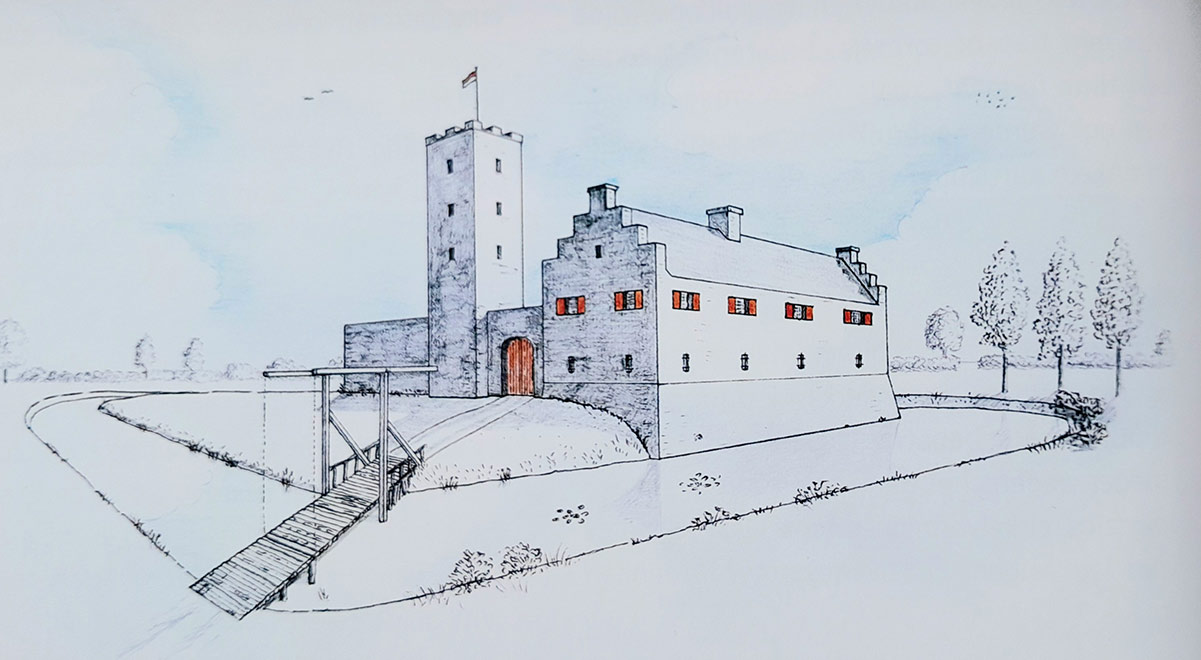
Above: artist’s impression of Portinc Castle by Hans Verdonk.
Portinc Castle in Bergeijk
Portinc Castle ( Sloth Bergheijck ) was the official residence of the Bac family in the 15th century and served as the administrative center for the district sheriff of Bergeijk. Around 1380, Hubertus Bac settled here as sheriff of Kempenland. He had the small castle built as a family home and workplace, probably even with a room for prisoners.
In a 1417 deed, the castle is specifically mentioned as the residence of the Bac family. Hubertus Bac and his wife Margaretha van Sittard had eight children here, including Jan and Hubert, who would later become famous as the painter van Eyck. There is no hard evidence that they were born in the castle, but it is highly likely that they spent their childhood there.
The castle remained in the family for centuries. First with the eldest son Hendrik (also sheriff of Kempenland) and later with the descendants of Jan Bac. It was finally sold in 1598 by Jonkheer Adam Bac. The castle was likely already in serious disrepair by then, due to the destruction wrought during the Eighty Years’ War.
From November 20, 2025, to April 5, 2026, the exhibition “Kasteel bekent Kleur” (Castle Shows Its Colour) can be admired at Cultuurhuis Bergeijk. It features all the information about Portinc Castle Bergeijk and its famous inhabitants 600 years ago. Thursdays through Sundays, 1:00 PM to 5:00 PM. Click on Cultuurhuis Bergeijk for more information.
The video below shows an image of Portinc Castle with a moon above it, in a painting by Jan van Eyck. The animation was created by working group member James Granger.

Dr. Lucas van Dijck’s book, which demonstrates that the world-famous painters Jan and Hubert van Eyck were born in Portinc Castle 600 years ago. The painting on the cover was created by BKV member Emile Kruip.
Highly recommended! Read the book:
Bergeijk, birthplace
of Jan and Hubert van Eyck
Dr. Lucas GCM van Dijck.
The work of the Van Eyck brothers and that of Hieronymus Bosch differs enormously, both in painting technique and depiction, as well as in iconography and visual language. One thing these artists have in common: their names. Jan van Eyck and Hieronymus Bosch explicitly signed their works with their own names. Jan van Eyck in short texts explaining his role as creator, Hieronymus Bosch with a signature that almost serves as a working name.
In this publication, Dr. Lucas van Dijck, archival researcher and Bosch expert, presents with near certainty the Brabant origins and family context of the Van Eycks: the solution to a mystery that is more than five hundred years old.
This beautiful hardcover book is available for €19.50, for example at Bruna Bergeijk.
The book is also available for purchase at Visit Bergeijk, the Bergeijk Cultural Center, and the Bergeijk Historical Society, Dokter Rauppstraat 35, on Tuesday evenings from 7:00 PM to 9:00 PM. You can also order the book by sending an email to info@heemkundekringbergeijk.nl , stating your name, full postal address, and email address. We will then contact you to process your order.
Discussion and collaboration
Who has the right to “Van Eyck”?
It will come as no surprise that the discovery of new archival sources about the Bac van Eyck family has led to a debate about the traditional view that Jan and Hubert van Eyck came from Maaseik. While Maaseik has cherished this tradition for centuries and is rightly proud of its Van Eyck heritage, new research points to Bergeijk as their most likely birthplace.
But instead of a dispute over the provenance, there is a plea for cooperation between Van Eyck cities such as Maaseik, Bruges, Ghent, Liège and Bergeijk, to present the life and work of the brothers jointly and with broad support.
Centuries-old tradition in Maaseik

Standbeeld gebroeders van Eyck op de markt in Maaseik
Maaseik was mentioned in chronicles as the birthplace of Jan and Hubert van Eyck as early as the 16th century. Although these early sources lacked hard evidence, a strong tradition grew from them. The statue in the Market Square has stood there since 1864, and shortly after the publication of Lucas van Dyck’s first book in 2022, the Van Eyck brothers were appointed honorary citizens of Maaseik at the suggestion of the Van Eyck Platform Maaseik.
This tradition is valuable and deserves recognition. Generations have kept the Van Eyck heritage alive and shared in Maaseik.
Not a point of contention but an opportunity
It would be easy to turn Lucas van Dijk’s new insights into a point of contention: Maaseik or Bergeijk? Who has a “right” to Van Eyck? But that opposition doesn’t do justice to the full story.
The truth is that the Van Eycks don’t belong to just one place. Their lives and work are connected to several cities: Maaseik and Bergeijk as their likely birthplaces or childhood homes, Liège as their bishopric of origin, Bruges and Ghent as their places of work and death.
Collaboration as a strength
Instead of competition, this presents an opportunity for collaboration. Municipalities and heritage institutions can join forces to tell the complete story. Not an either-or, but a both-and.
In short:
Maaseik can remain proud of its role as an early advocate of Van Eyck. Thanks to new archival research, Bergeijk can reveal its own place in the story. Together with Bruges, Ghent, and Liège, this creates a richer, more honest, and more complete picture of these exceptional artists and their era.
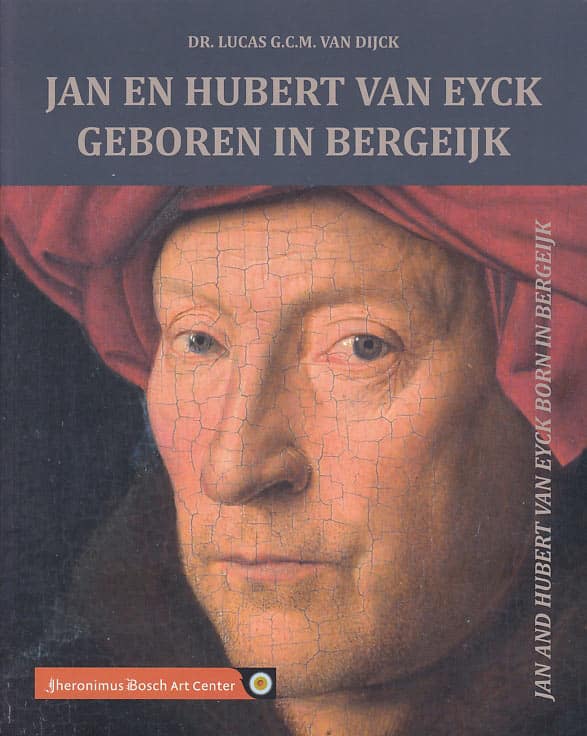
The book “Jan and Hubert van Eyck Born in Bergeijk” is the first book by Dr. Lucas van Dijck, published by the Jheronimus Bosch Art Center in 2022. A revised edition of this book was published in 2025, providing additional evidence for the conclusion that the Van Eyck brothers were not born in Maaseik but in Bergeijk and spent their youth there.
Also watch the video below.
Of course, there are also critical voices and questions. Below you’ll find the most important questions and points of interest.
There is no formal birth certificate or baptismal certificate.
The biggest weakness in Van Dijck’s theory is that he has no direct evidence of a birth in Bergeijk.
- There is no baptismal register or notarial deed with: Jan van Eyck, born in Bergeijk.
- Dialectal features in Van Eyck’s notes would better fit the Maasland.
- The core of his evidence is indirect: a deed from 1417 in which Jan and Hubert Bac are mentioned as brothers from Eyck.
- This certainly makes the conclusion “they were born in Bergeijk” plausible, but not proven.
Why suddenly abolish all that tradition based on one found deed?
Maaseik has an old tradition, but no contemporary evidence to support the theory that the Van Eycks were born there.
Proponents of Maaseik point out that:
- Maaseik has been mentioned as a birthplace in several chronicles since the 16th century (Van Vaernewijk, Van Mander, D’Heere).
- That tradition has not been convincingly refuted for more than 400 years.
- That local tradition, the statue and honorary citizenship also have their value.
- Texts on drawings of the funerary epitaph in Bruges (from the 16th century) also mention Maaseik as the place of birth.
Other critical questions about the interpretation of the deed.
Other critical questions about the interpretation of the deed.
- Is “Jan and Hubert Bac from Eyck” the same Jan and Hubert called Van Eyck?
- Could Eyck mean another Eyck? (There are more places with that name.)
- Is the Bac family from the deed really without doubt the painter’s family?
- Why are other known elements (such as brother Lambert) missing from that deed?
✅ Van Dijck does provide an explanation (for example, Lambert as a bastard without inheritance rights), but it remains a hypothesis
Historical research isn’t really suited to probability theory, but I actually believe this already proves we’re dealing with the famous painters. The chance that, just as in Bergeijk, a family with sons Hubert and Jan also lived in Maaseik at the same time, the latter also having a wife named Margareta, is practically zero, in my opinion.
Dr. Martin W.J. de Bruijn, medievalist
More information
Video and some atmospheric images
Want to see more video`s on this topic? Click here!

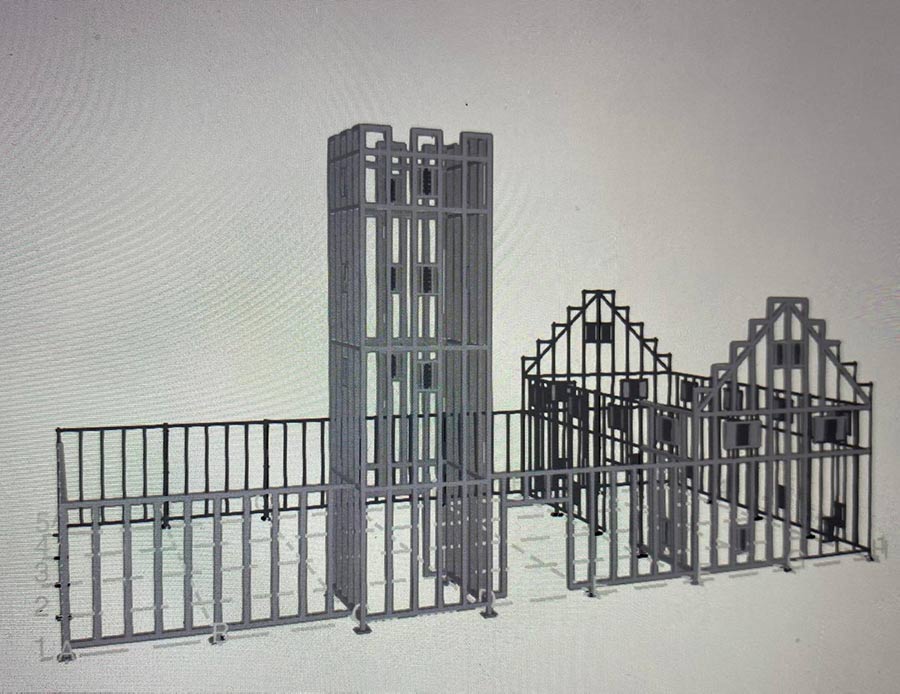
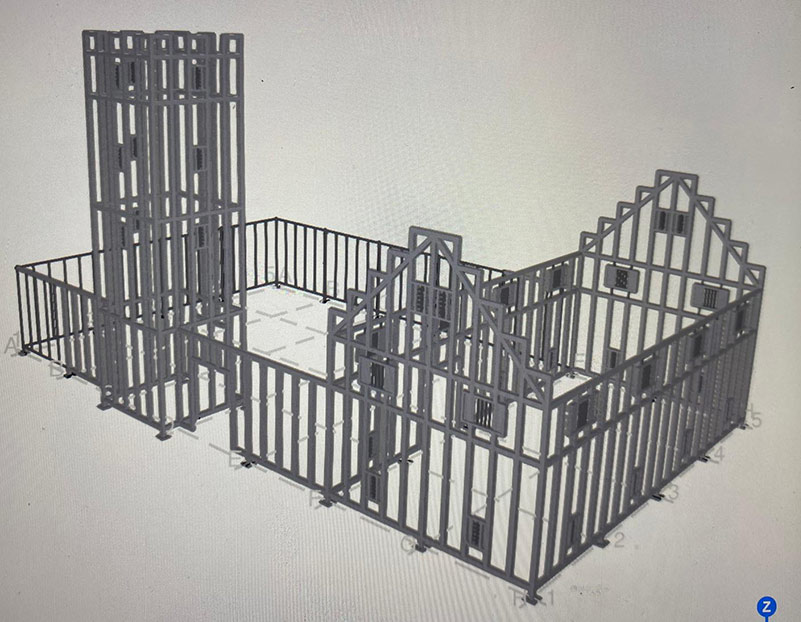

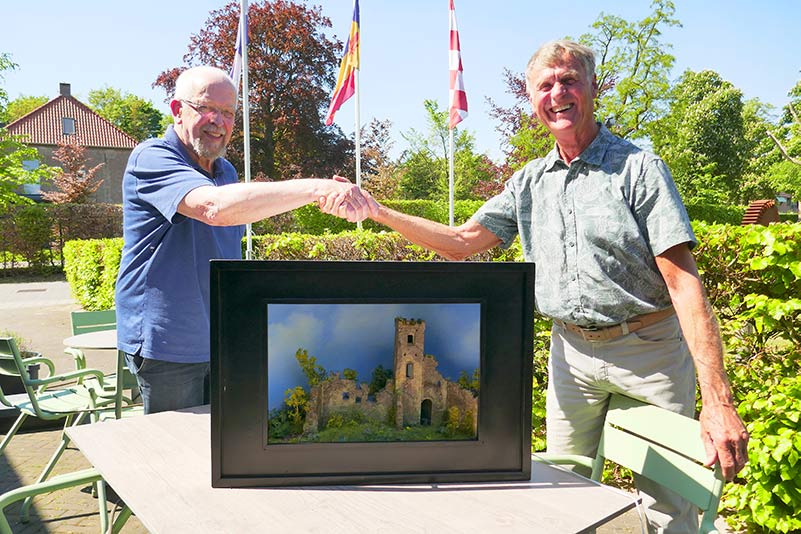
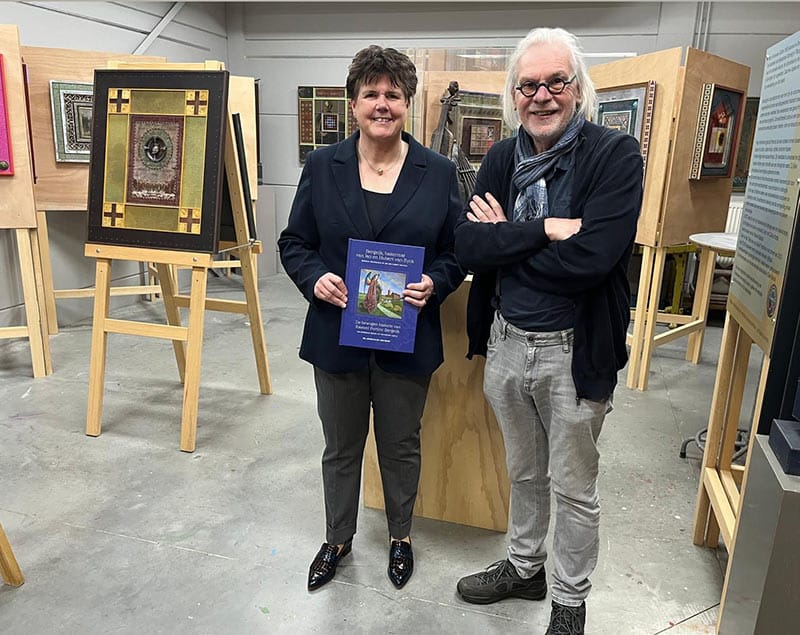

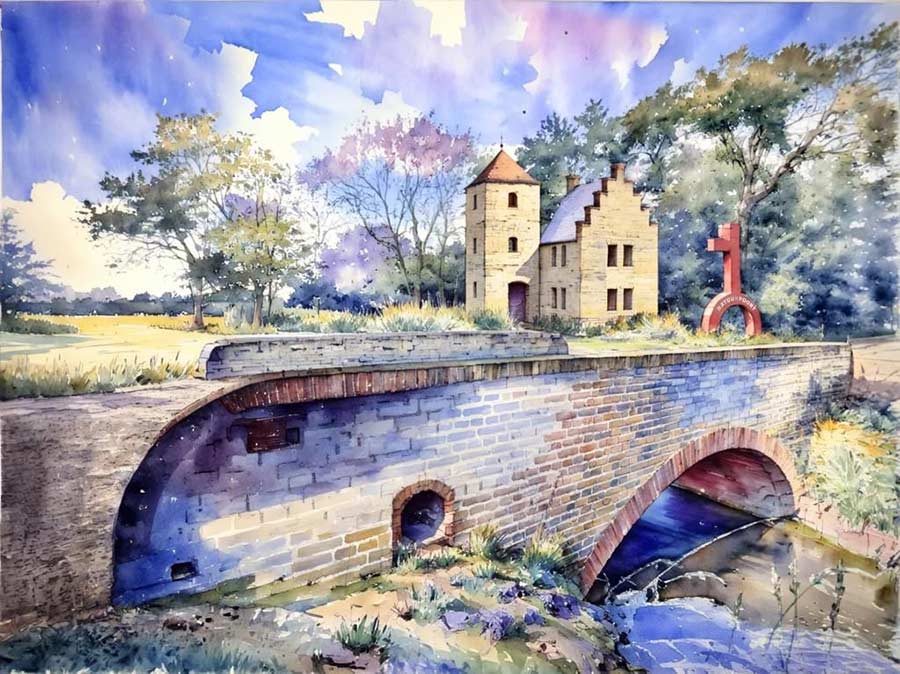
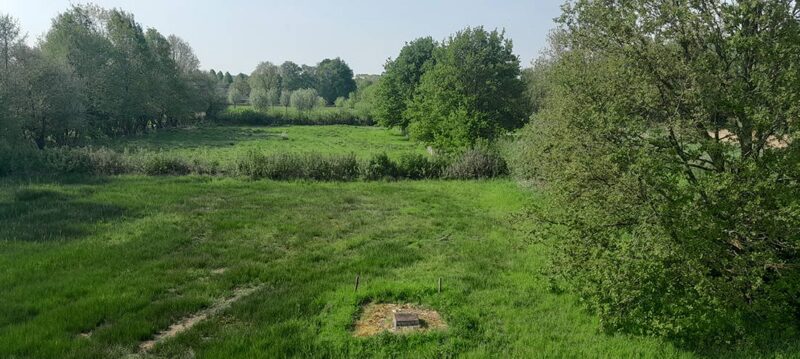


Take a Walk around Portinc Castle
Location & walking Route
Entrance to the castle site: Lijnt, 5571 GA Bergeijk (next to the fire station)

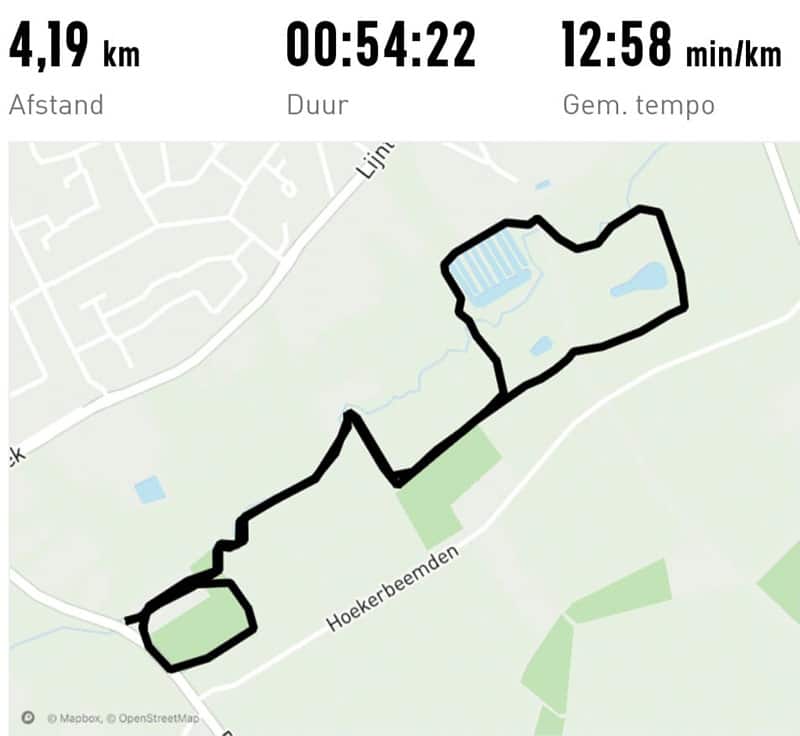
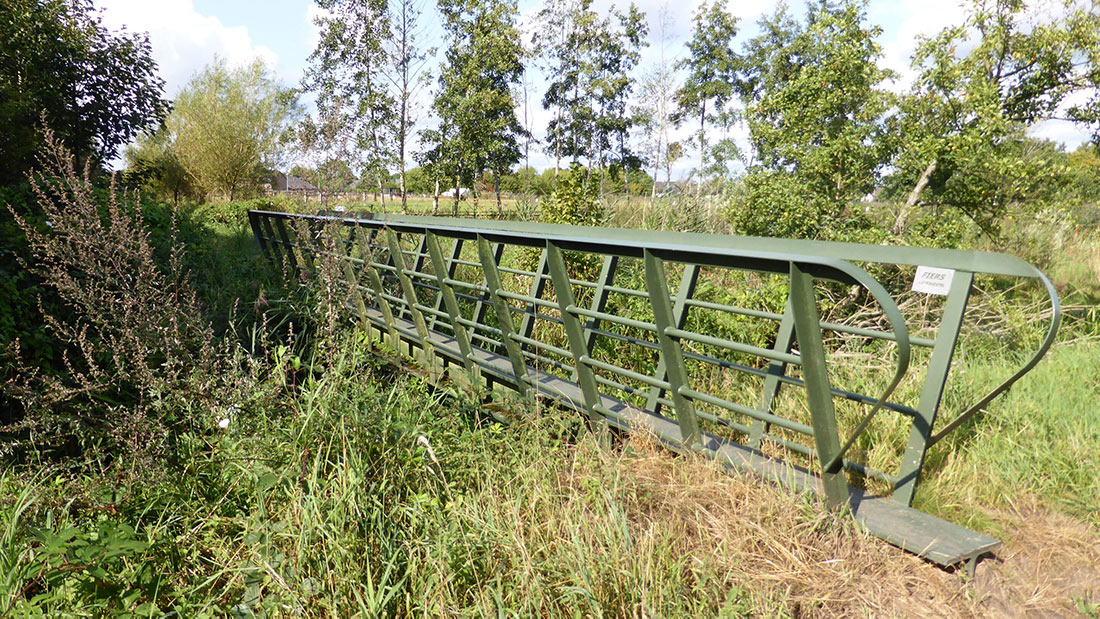

Walk around Portinc Castle
Hidden history
This walking route takes you past a remarkable piece of local history in a green setting. Near the Keersop once stood Portinc Castle, a fortified stronghold first mentioned as early as 1352. It had its own church and a few houses for staff, surrounded by a wide moat. Because noble families were rare in the Kempen region, this castle stood out even more.
Castle in wartime
During the Eighty Years’ War, Portinc Castle was the scene of several battles. Both Prince Maurice’s troops and the Spanish army captured it temporarily. Over the course of the 19th century, the castle—then known as “Sloth Bergeyck”—fell into disrepair. Today, nothing remains. However, traces of the castle can still be seen in the Bergeijk Cultural Centre, such as remnants of a stained-glass window.
Van Eyck: from Bergeijk?
As you can read on this site, there are strong indications that the famous painters Jan and Hubert van Eyck were born in this castle.
Walking through nature and history
The site where the castle once stood is now part of a beautiful (and free) stream walk. Most of the route runs through a nature reserve. At the start of the walk, the contours of the old moat are visible. Further on stands a lookout tower, and along the way you’ll also pass the Keersop, where a watermill once operated. A section of the millstone can be seen in the Cultural Centre.
Starting point of the route
The walk begins at the information board on De Lijnt in Bergeijk. Lace up your walking boots and discover how nature and history intertwine here.
Umbrella Organisation and Partners
About us

Portinc Van Eyck Foundation
The Portinc Van Eyck Foundation was established in 2025 and grew out of the Van Eyck Dome, Portinc Castle Bergeijk, which was established in 2024. This is a local umbrella organization in which the Bergeijk Local History Society , Bergeijk Cultural Center , Visit Bergeijk , and the Heeren van Eyck Society collaborate to research, preserve, and tell the story of the Van Eycks in Bergeijk.
The Portinc Van Eyck Foundation is responsible for implementing the “castle program.” De Stichting Portinc Van Eyck is responsible for the implementation of the “castle program.” Periodically, the foundation issues a news update on the progress of this program.

Visit Bergeijk Foundation
Visit Bergeijk aims to actively contribute to the well-being of the residents of the municipality of Bergeijk and strengthen Bergeijk’s competitive position as a village in which to live, work, visit, and stay. Visit Bergeijk achieves this by showcasing Bergeijk’s attractiveness and unique offerings, telling the stories in the right places, making them relevant today, and facilitating events in and by Bergeijk through co-financing.

Craft and Culture Support Foundation
The ‘Stichting Ambacht en Cultuur Support’ is a fund that supports special, exclusive cultural (historical) and high-profile initiatives in the field of ’tangible and intangible heritage’. These
include monuments, art activities/works, archaeological sites, traditions, rituals, folklore, craft training, and history education.
Contact:
studio@eyckehorst.nl

Bergeijk Local History Society
The Bergeijk Local History Society aims to research and study aspects of local history, such as history, folk life, landscape development, toponyms, and environment. It also preserves and/or safeguards local history objects, objects, vernacular, archaeological data, and archives. It promotes publications, lectures, and exhibitions in the field of local history.
Questions?
Get in touch!

Contact: Rob Lohman
(+31) 06 534 90 721
Entrance to the castle site: Lijnt, 5571 GA Bergeijk (next to the fire station)
bestuur@portincvaneyck.nl
Contactformulier:
Privacy Policy
General information
We attach great importance to the privacy of our visitors. On this page we explain which data we collect and how we handle it.
1. Personal data we process
We process your personal data when you use our services and/or because you have provided it to us yourself. This may include:
- Name
- Email address
- Address details
- Telephone number
- Other information you actively provide (for example in the message you send via our contact form)
2. Purposes of processing
We use your data to:
- Contact you if necessary to provide our services
- Answer your questions
- Improve our website and make it more user-friendly
- We do not use your data for third parties’ commercial purposes and we do not sell it.
3. Retention period
We do not keep your data longer than necessary to achieve the purposes for which it is collected.
4. Sharing with third parties
We only share data with third parties if this is necessary to handle your question or request.
5. Accessing, correcting or deleting your data
You have the right to access, correct or have your personal data deleted. You can contact us for this using the contact details under section 7.
6. Security
We take appropriate measures to prevent misuse, loss, unauthorised access and unwanted disclosure.
7. Contact
Do you have questions about this privacy statement? Please feel free to contact us:
Stichting Van Eyck/Kasteel Portinc Bergeijk
Rob Lohman
Dorpstraat 21a
5563 BC Westerhoven